Opening Shot
with Mark Wilson

Question:
Whenever I find it necessary to use a power stroke, I tighten up and my entire stroke feels less natural. How do you maintain the fluidity and accuracy of your stroke when using a power stroke?
– Terry Winkler, Cape Girardeau, Mo.
Answer:
Combining accuracy and power is the most difficult endeavor in all sports. What distinguishes elite pool players is their ability to hit a 57mm cue ball with a 12.5mm tip within a 1mm margin of error on long power strokes. Doing 50 focused reps per day with long flowing final strokes while having your eyes closed is a great method. You can feel for a seamless and fluid transition. If you feel the transition is jerky, this is not a failure. It’s valuable feedback. Place the cue ball on the spot and shoot to the far corner pocket. Observe the feeling and the tip finish for straightness. Shoot some of these training shots without a practice stroke. It will force the initial setup to be ideal. It’s also critical that you perform these reps with a high level of mental focus and discipline.
Become A Shot Maker
BD House Pro: Tony Robles
Are you a shot maker? Deep down, I think everyone who plays pool wants to be known as a great shot maker. Great safety play and pin-point position is every bit as important, but the players you really remember and love to watch are the great shot makers — Earl Strickland, Mike Sigel, Jayson Shaw, Shane Van Boening.
So, this month, let’s have some fun and give you a drill that will allow you to let your stroke out for some shot-making fun.
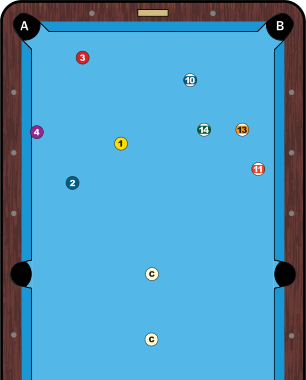
As the diagram shows, place the cue ball on the center spot. Spread four solids out on the left side of the table and four striped balls out on the right. They can be anywhere on one side of the table, provided each ball has an open path to a corner pocket.
Start by pocketing all four solids into pocket A using only draw. Don’t worry about where the cue ball goes. We’re just concerned here with pocketing balls. Once you’ve made a ball, move the cue ball back to the center spot and shoot the next ball. Now, shoot the four striped balls into pocket B, also using draw.
When you can consistently pocket all eight balls without missing, repeat the drill, only this time use stun instead of draw. Hit each shot so that the cue ball has no spin on it at the moment it contacts the object ball.
After you’ve mastered this exercise, set it up again and shoot the balls in using follow.
Keep at this until you are above 90 percent success.
When you’ve achieved that mark, start the drill again with the cue ball one diamond further back, keeping it along the center line. Some of these shots will become noticeably more difficult because the added distance makes the angles tougher.
Your shot-making skills and consistency will improve as you repeat the drill because you’re forcing yourself to adjust your stroke for draw, stun and follow, while still aiming at the same contact point on the object ball. Among other advantages, this drill will help you become multi-dimensional.